
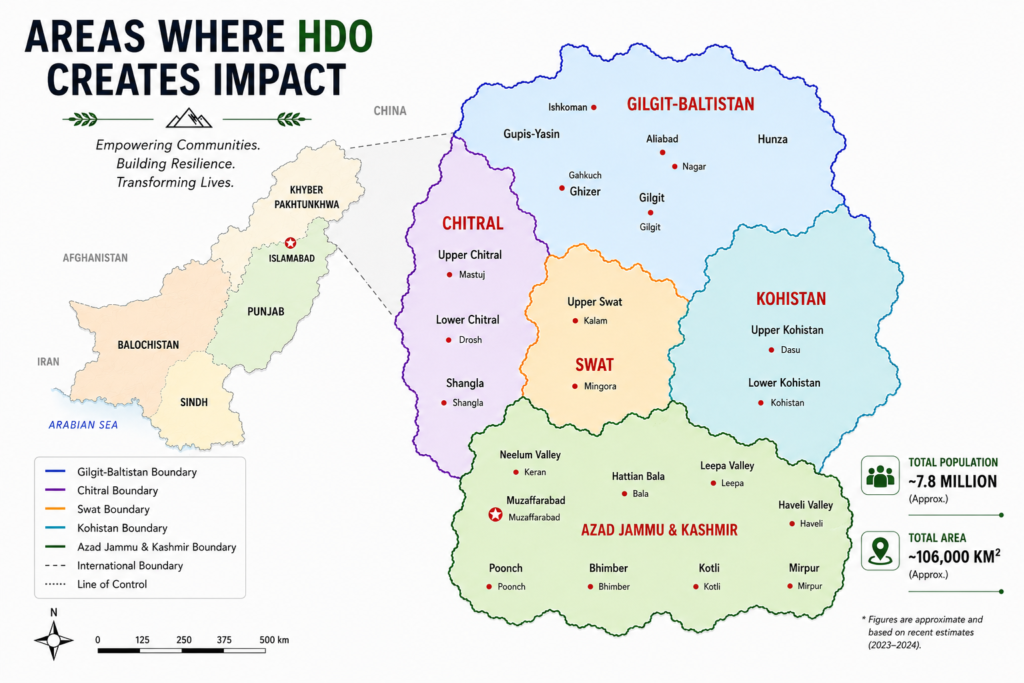
Himalayan Development Organization (HDO)’s vision of resilient, self-reliant, socially and economically empowered communities is rooted in the realities of Pakistan’s Himalayan region. HDO is currently operates across Gilgit-Baltistan, Chitral, Sawat, Kohistan and Azad Kashmir (AJK), five geographically connected yet administratively distinct territories that share similar development challenges despite different governance systems, cultures, and languages.
1- Gilgit-Baltistan
Baltistan is Pakistan’s northernmost mountainous region, bordering China, Afghanistan and India containing some of the world’s largest glaciers outside the polar regions.
Gilgit-Baltistan covers an area of 72,971 square kilometers (28,174 square miles), making it the largest administrative region of Pakistan by land area. Despite its vast mountainous landscape, the region has an estimated population of approximately 2.1 million people (2025 projection based on the 2023 Digital Population Census), resulting in a relatively low population density and widely dispersed settlements across its remote valleys and high-altitude communities.
In addition to fragile mountain ecosystems, dispersed communities, and growing climate risks, GB’s rapid population growth, expanding settlements, and inadequate public services have outpaced investments in infrastructure, public services, and employment generation.
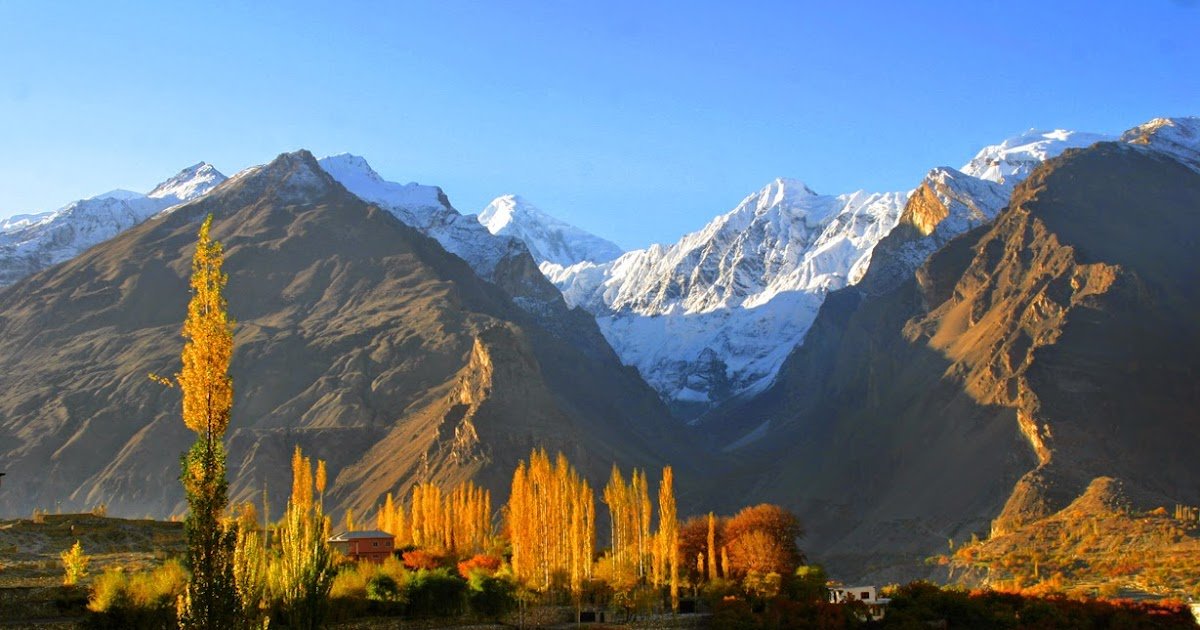
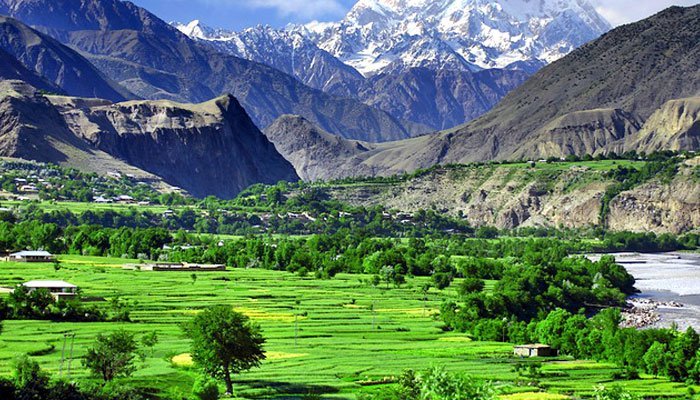
2- Chitral (Khyber Pakhtunkhwa, Province)
Situated in the Province of Khyber Pakhtunkhwa bordering Afghanistan to the north and west, Gilgit-Baltistan to the east. Chitral district covers an area of 14,850 km² and the total population of Chitral is 516,000 as of 2023. Chitral consists of Upper and Lower Chitral districts and is characterized by high mountains, isolated valleys, and rich cultural diversity, including the indigenous Kalasha communities. Chitral is facing environmental vulnerability and limited economic opportunities.
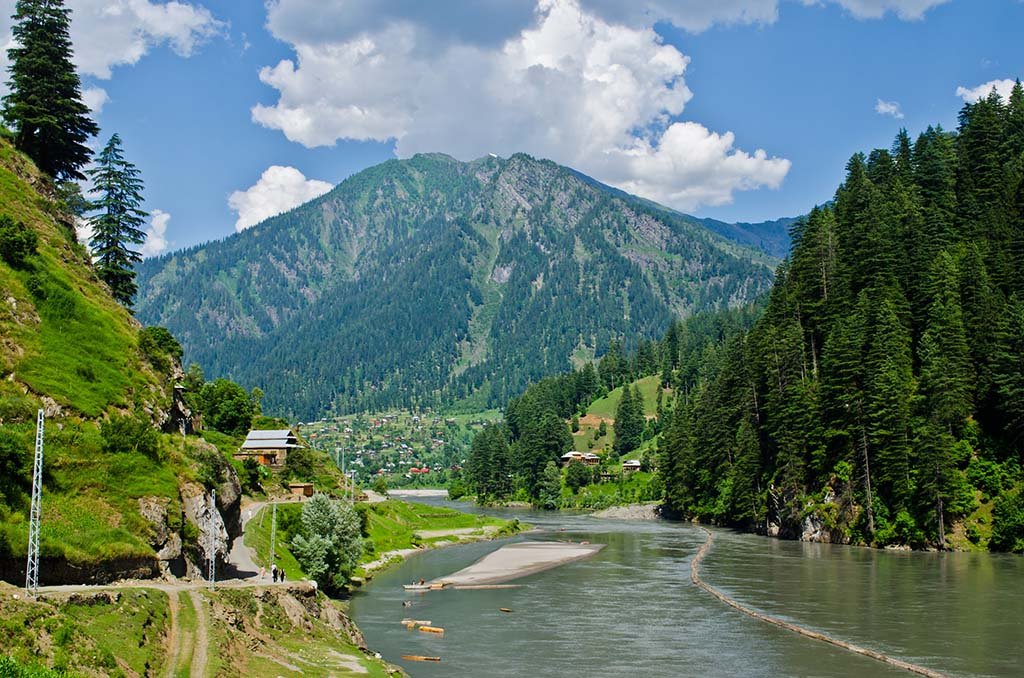
3- Azad Kashmir
Azad Kashmir covers an area of approximately 13,297 km² and has a population of over 4.33 million as of 2023, spread across ten districts including Muzaffarabad, the capital, and other key areas like Neelum, Bagh, and Kotli
Geographically, it lies along the western Himalayas, bordered by the Indian-administered Jammu and Kashmir to the east, Gilgit-Baltistan to the north, and the Pakistani provinces of Punjab and Khyber Pakhtunkhwa to the south and west.
The region features mountainous terrain, terraced valleys, and fertile plains, with the Jhelum River forming much of its western boundary. It continues to face several structural socioeconomic challenges, including unemployment and underemployment, poverty and income inequality, dependence on remittances, many of these are linked to its mountainous geography, limited industrial base, and high exposure to natural disasters and climate change.
The common Challenges of GB, Chitral and AJK
Although administered under three different governments, Gilgit-Baltistan, Chitral, and Azad Jammu & Kashmir share a common development landscape. Mountain ecosystems transcend administrative boundaries, and so do the challenges of climate change, disasters, environmental degradation, rural poverty, women’s poor socio-economic conditions, migration, and social exclusion.
- Unemployment and Underemployment
- Poverty and Income Inequality
- Dependence on Remittances
- Limited Industrial and Private Sector Growth
- Agricultural Constraints
- Climate Change and Natural Disasters
- Infrastructure Gaps
- Healthcare Challenges
- Education and Skills Mismatch
- Low Women’s Economic Participation
- Tourism Development Constraints
These issues collectively hinder inclusive economic growth, sustainable livelihoods, and long-term regional development.
One Himalayan Development Approach
HDO therefore applies one integrated institutional model throughout the Himalayan region. The Central Programme Unit provides strategic leadership, programme design, resource mobilization, grant management, monitoring, evaluation, and partnerships. Regional Field Units coordinate district-level implementation, technical support, and stakeholder engagement, while the Community Partner Network, including Village Organizations, Women Organizations, youth groups, producer organizations, cooperatives, and local NGOs, ensures that development remains community-owned, participatory, and sustainable. This integrated delivery mechanism enables HDO to combine enterprise development, education and skills, climate resilience, disability inclusion, health, and community social development into a single, locally driven model for long-term resilience and inclusive growth.
HDO’s Initiatives:
HDO’s initiatives are designed to address these socio-economic and environmental challenges through integrated, community-centered development approaches. The organization focuses on the following key intervention areas:
- Climate-resilient infrastructure and disaster risk reduction.
- Sustainable livelihood diversification.
- Youth employment and entrepreneurship.
- Women’s socio-economic empowerment.
- Climate-smart agriculture and value chain development.
- Digital skills and vocational training.
- Sustainable tourism development.
- Water, sanitation, and hygiene (WASH).
- Renewable energy for remote communities.
- Improved health and education service delivery.
These development priorities are closely aligned with the mission of the Himalayan Development Organization (HDO), whose interventions focus on strengthening climate resilience, promoting sustainable livelihoods, enhancing community-based disaster risk management, advancing women’s economic empowerment, and equipping youth with market-relevant skills across mountain communities.